
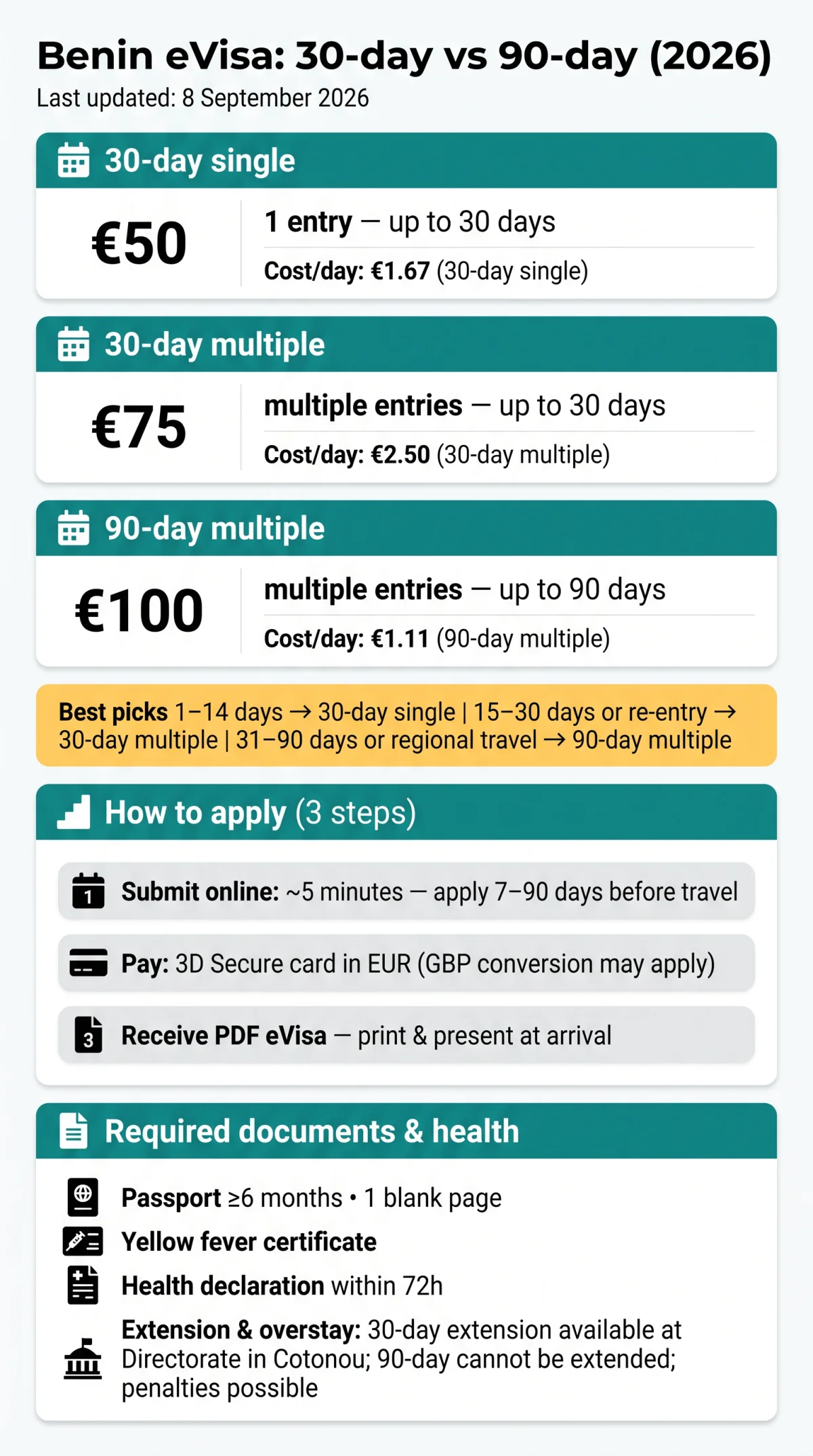
Benin offers three eVisa types in 2026: a 30-day single entry (€50), a 30-day multiple entry (€75), and a 90-day multiple entry (€100). Choosing between a Benin evisa 30 days vs 90 days comes down to trip length, entries, and budget. This guide compares all three options for UK travellers. It also covers stay rules, penalties, and extensions.
Last updated: 8 September 2026. Fee and validity details verified against the Benin government eVisa portal and the Directorate of Immigration in Cotonou. This is an independent travel information portal, not a government service.
Benin eVisa 30 Days vs 90 Days – Full Comparison Table
Benin eVisa 30-day single entry (€50), 30-day multiple entry (€75), and 90-day multiple entry (€100) differ in entries, validity, and cost. UK passport holders require a visa for any trip to Benin.
Validity for all three options starts from the entry date declared on the application form, not the date of issue or approval.
| Visa Type | Entries Allowed | Maximum Stay | Cost (EUR) | Best For | Recommended Trip Length |
|---|---|---|---|---|---|
| 30-day single entry | 1 entry | Up to 30 days | €50 | Short trips with no re-entry | 1-14 days |
| 30-day multiple entry | Multiple entries | Up to 30 days | €75 | Short trips requiring re-entry into Benin | 15-30 days |
| 90-day multiple entry | Multiple entries | Up to 90 days | €100 | Long stays or regional travel with re-entry | 31-90 days |
How the 90-Day Multiple-Entry Benin eVisa Works
Benin 90-day multiple-entry eVisa validity starts from the first entry date and allows unlimited re-entries within the 90-day window.
Cumulative stays are permitted: enter for 30 days, leave, and re-enter for another 30 days, all within the same 90-day validity period. Example: spend 28 days in Benin, fly to Lomé for 5 days, then re-enter Benin for 14 more days, all within one 90-day window. This saves purchasing a second visa.
The 30-day single-entry eVisa is invalidated upon departure from Benin; no re-entry is possible under this visa type, making it unsuitable for itineraries involving side trips to neighbouring countries.
Benin eVisa Fees – Cost Breakdown by Visa Type
Benin eVisa government fees are €50, €75, or €100 payable by 3D Secure card in EUR; GBP conversion charges may apply for UK travellers.
| Visa Type | Government Fee | Cost per Day | Recommended Trip Length |
|---|---|---|---|
| 30-day single entry | €50 | €1.67 | 1-14 days, no re-entry |
| 30-day multiple entry | €75 | €2.50 | 15-30 days or re-entry |
| 90-day multiple entry | €100 | €1.11 | 31-90 days or regional travel |
The 90-day Benin eVisa at €100 yields the lowest cost per day at €1.11 versus €1.67 for the 30-day single. The 30-day single costs €50 self-service or €60 embassy-assisted; commercial portals add a service fee on top. All government fees are payable by 3D Secure Mastercard in EUR; UK travellers face GBP conversion fees from their card issuer. Issued eVisas are non-refundable and cannot be modified.
Benin eVisa 30 Days vs 90 Days – Which Visa to Choose by Trip Type
Choose 30-day single entry for trips under 14 days, 30-day multiple entry for 15-30 days with re-entry, and 90-day multiple entry for regional travel over 30 days.
- 1-14 days, no re-entry: 30-day single entry (€50) – backpackers and short tourists
- 15-30 days or side-trips requiring re-entry: 30-day multiple entry (€75) – tourists with regional itineraries
- 31-90 days or regional travel through Benin plus Togo, Nigeria, or Burkina Faso: 90-day multiple entry (€100) – business travellers and regional explorers
The 90-day visa (€100) avoids the extension process for trips over 30 days. UK travellers comparing a Benin evisa 30 days vs 90 days should weigh itinerary flexibility against cost.
How to Apply for a Benin eVisa – Step-by-Step Process & Ports of Entry
Apply for a Benin eVisa online in under 5 minutes; standard processing time is 24-48 hours (up to 96 hours for manual review). Apply at least 7 days before travel and no more than 90 days before your intended entry date.
Submit the online application
Provide personal and passport data, including passport expiry date and email address.
Complete expert review and payment
Pay using a 3D Secure Mastercard in EUR (GBP conversion fees may apply for UK card issuers).
Receive the eVisa as a PDF
Print and present it with your passport at immigration upon arrival.
The eVisa is accepted at the following ports of entry: Cotonou Airport (primary eVisa issuance point), Porga Airport, Port of Bohicon, and land borders with Togo, Nigeria, and Burkina Faso (limited to extreme necessity and authorized in liaison with bordering countries).
Benin eVisa Document & Health Requirements
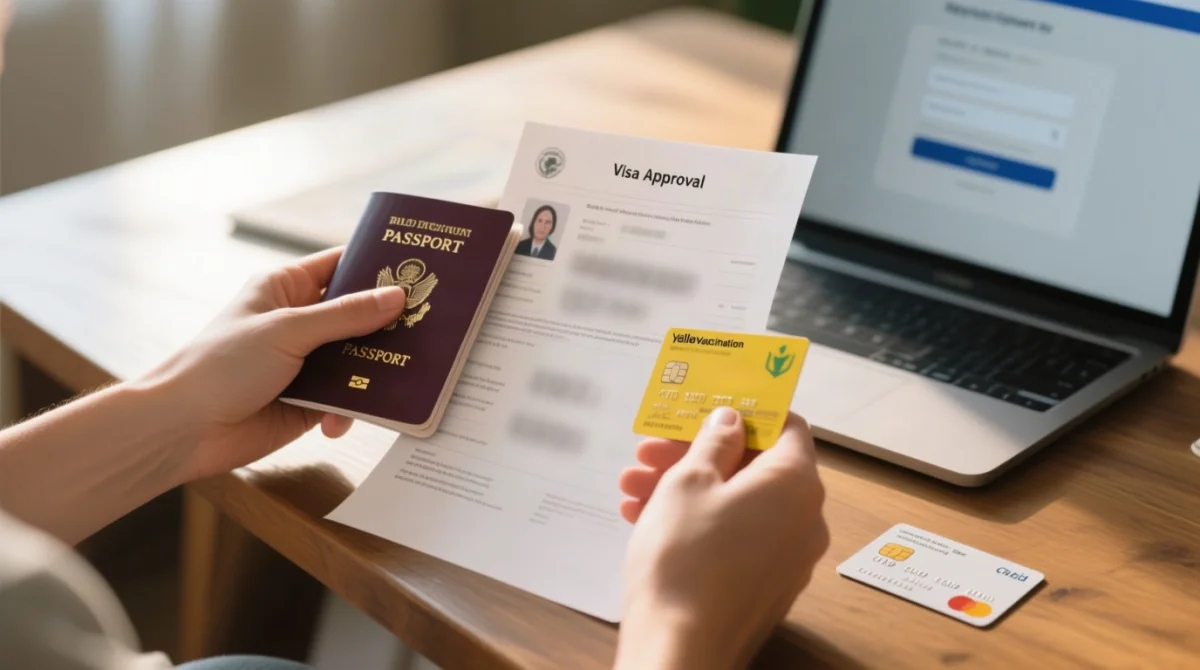
Benin eVisa requires a passport valid for at least 6 months from the date of arrival, with at least one blank page, plus a mandatory yellow fever vaccination certificate.
A health declaration form must be submitted within 72 hours before travel. COVID-19 tests are no longer required in 2026; if testing positive on arrival, treatment is free of charge with government-mandated isolation. Border officials may check for a return or onward ticket dated within the visa validity window. Proof of sufficient funds is not published by Benin authorities but advisable for UK travellers. Travel insurance is recommended but not mandatory.
Note: 61 countries and territories are visa-free for Benin, and all African nationals receive visa-free entry for 90 days. Over 140 nationalities can apply for the eVisa online. Venezuela’s visa waiver is signed but not yet in force as of 2026. Long-term stays and work permits require application at a Benin embassy or consulate, not via eVisa. Nigeria and Ghana entry visas cannot be obtained in Benin; Togo entry visas can be acquired at the Togolese Embassy in Cotonou or at the Togo-Benin border.
Overstay Rules & Visa Extension for Benin eVisa
Overstaying a Benin eVisa triggers daily financial penalties (amounts unpublished) and deportation risk; a 30-day extension is available at Cotonou’s Directorate of Immigration.
The Directorate of Immigration (Direction de l’Immigration) in Cotonou handles in-country extensions for 30-day visa holders; applicants must bring a passport, photograph, completed form, and reason for extension. The 90-day Benin eVisa cannot be extended beyond 90 days; travellers needing longer stays must apply at a Benin embassy or consulate. Border officials may also check for a return or onward ticket dated within the visa validity window.
FAQ
What is the difference between a 30-day and 90-day Benin eVisa?
The 30-day single-entry Benin eVisa (€50) allows one entry for up to 30 days. The 90-day multiple-entry Benin eVisa (€100) allows unlimited re-entries within a 90-day window for longer stays or regional trips.
How much does a Benin eVisa cost: 30 vs 90 days?
Government fees are €50 for the 30-day single entry, €75 for the 30-day multiple entry, and €100 for the 90-day multiple entry. Embassy-assisted fees start at €60; commercial portals add service fees. Payment is in EUR via 3D Secure card.
Can I enter Benin multiple times with a 90-day eVisa?
Yes. The 90-day multiple-entry Benin eVisa allows unlimited re-entries within the 90-day validity window from your first entry date. The 30-day single-entry visa does not allow re-entry.
Which Benin eVisa should I choose for a 2-week trip?
For 1-14 days with no re-entry, the 30-day single-entry Benin eVisa (€50) is the best and cheapest option.
Can I extend my 30-day Benin eVisa while in the country?
Yes. Apply at the Directorate of Immigration in Cotonou with a passport, photo, completed form, and reason for extension. If you need more than 30 days, the 90-day Benin eVisa (€100) is more practical.
What happens if I overstay my Benin eVisa?
Daily financial penalties apply (amounts unpublished) and deportation is possible. Overstaying may negatively impact future Benin visa applications.
Do I need a return ticket to enter Benin with an eVisa?
Not strictly required for issuance, but border officials may check for a return or onward ticket dated within your visa validity window. UK travellers should carry proof of sufficient funds.
How long does Benin eVisa approval take?
Standard processing time is 24-48 hours; maximum 96 hours for manual review. Apply at least 7 days before travel. The Benin eVisa is delivered by email as a PDF.
Is the Benin eVisa valid from the date of issue or the date of entry?
Validity starts from the entry date declared on the application form, not the date of issue. This applies to all three Benin eVisa types: 30-day single, 30-day multiple, and 90-day multiple entry.
Can UK citizens apply for a Benin eVisa online?
Yes. UK passport holders require a visa and are eligible for the online Benin eVisa. Over 140 nationalities can apply online; the simplified form takes under 5 minutes via phone or PC.
Is there a grace period if I arrive late with a Benin eVisa?
No grace period is published. The Benin eVisa validity starts from the entry date declared on your application form; arriving after that date may reduce your permitted stay within the validity window.