
This Benin eVisa vs other African eVisas comparison: Benin costs €50 to €100, processes in 3 to 5 working days, and covers Benin only. Versus Kenya ($51), Tanzania ($50), Ethiopia ($82), and Ghana ($150), Benin is mid-range and among the fastest.
Published: 8 September 2026. Last updated: 8 September 2026. This article references third-party visa processing services. benin-visa.com is NOT affiliated with the Benin Government. Always verify requirements on the FCDO website before travelling.
What Is the Benin eVisa and Who Needs One?
UK passport holders must obtain a Benin eVisa for all stays, despite 61 other nationalities enjoying visa-free entry to Benin.
The Benin eVisa is an electronic authorisation from the Government of Benin; no stamp or label is placed in the passport. This web-based system replaced the consular service and delivers the approved eVisa as a PDF via email. UK passport holders require a visa for every stay, obtainable as an eVisa online or as a visa on arrival at Cotonou Airport.
In contrast, 61 countries are visa-exempt, including all African nations, Haiti, Indonesia, Israel, and Macau; Hong Kong and Singapore passport holders receive 14 days visa-free under a visa waiver arrangement. Kenya’s eTA and Rwanda’s ETA (Electronic Travel Authorization) similarly require UK citizens to apply.
A yellow fever vaccination certificate is mandatory (gov.uk). Passports must be valid for the duration of stay, with 6 months carried as a practical buffer, and at least 1 blank visa page. COVID-19 vaccination proof and negative PCR tests are no longer required as of 2026. A health travel form is recommended, with registration up to 72 hours before travel. The FCDO advises against all travel to some parts of Benin and against all but essential travel to other regions.
How to Apply for a Benin eVisa: Step by Step
The Benin eVisa application consists of five online steps taking roughly five minutes to complete on the e-visa portal.
Access the Benin e-visa portal
Web-based; accessible from phone or PC
Complete the online application form
Personal data, travel dates, passport details; ~5 minutes
Upload digital passport photo and passport scan
Passport copy must be valid at least 6 months beyond visa expiry
Pay the visa fee online
EUR accepted; credit/debit card; note GBP to EUR conversion for UK applicants
Receive approval notification via email
PDF eVisa document
Print the Benin eVisa and carry it with your passport on arrival at Cotonou Airport. The FCDO (gov.uk) advises applying at least 7 days before departure. Track your Benin eVisa status via the portal using your Application Reference Number, Passport Number, and Email Address. Third-party services (CIBTvisas, MasterFastVisas) offer assisted applications with non-refundable service fees of £15 to £30. Note: benin-visa.com is NOT affiliated with the Benin Government.
Benin eVisa Fees vs Other African eVisas: Cost Comparison
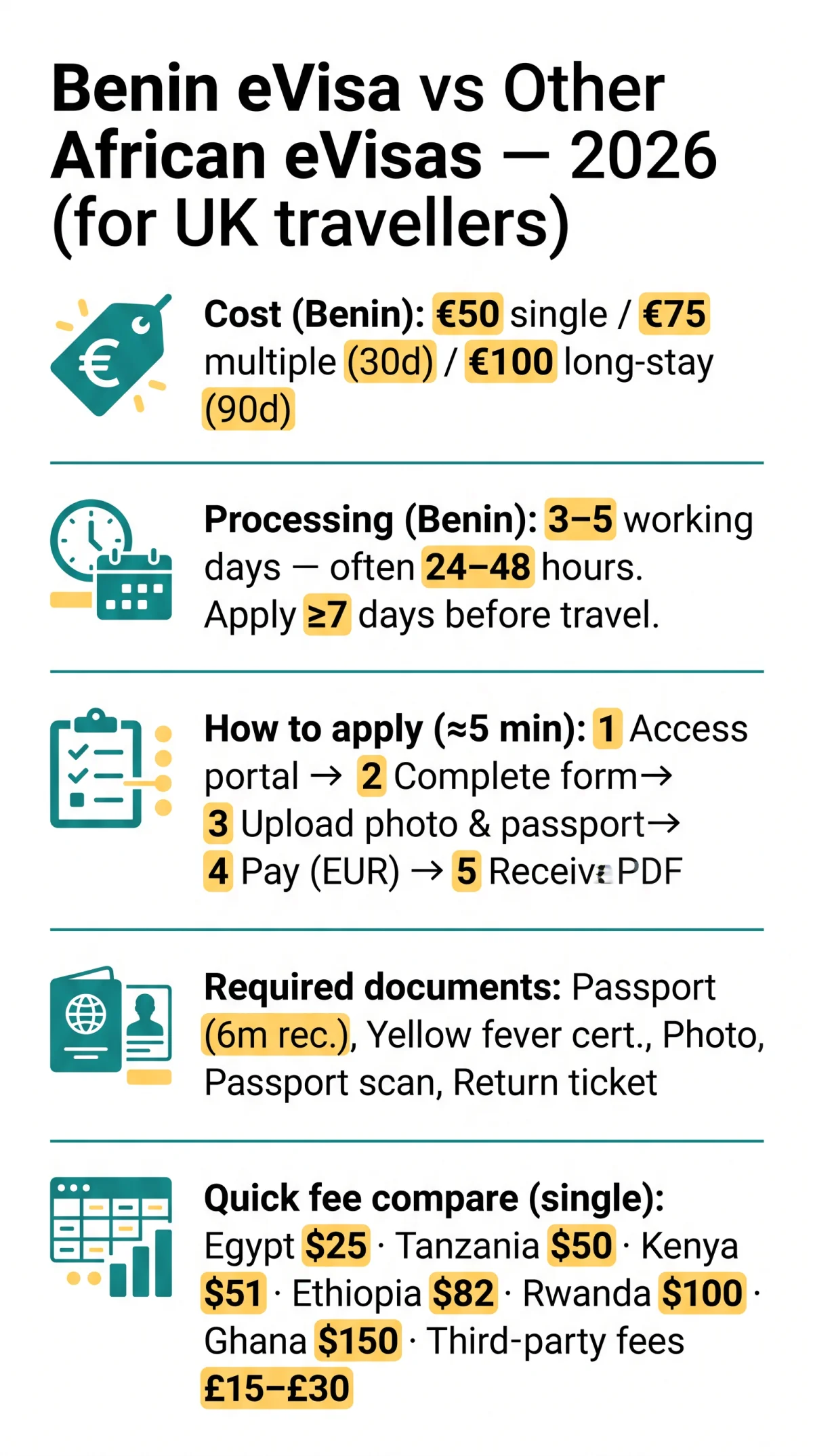
Benin’s €50 to €100 eVisa is mid-range among African systems, cheaper than Ghana’s $150 but costlier than Egypt’s $25 single-entry tourist visa.
The Benin eVisa costs €50 for single entry (30 days, ~£43), €75 for multiple entry (30 days, ~£65), and €100 for multiple entry (90 days, ~£86). Egypt is cheapest at $25, Ghana most expensive at $150, with Benin mid-range.
| Country | Fee (Single) | Fee (Multiple) | Currency | Est. GBP |
|---|---|---|---|---|
| Benin | €50 | €75 / €100 | EUR | £43 / £65 / £86 |
| Kenya (eTA) | $51 | $101 | USD | ~£40 / ~£80 |
| Tanzania | $50 | N/A | USD | ~£40 |
| Rwanda (ETA) | $100 | N/A | USD | ~£80 |
| Ethiopia | $82 | $102 | USD | ~£65 / ~£81 |
| Egypt | $25 | N/A | USD | ~£20 |
| Ghana | $150 | N/A | USD | ~£119 |
The Benin eVisa system charges in EUR, while most East or Southern African systems charge in USD, meaning UK applicants face GBP conversion costs on both. Third-party processors add £15 to £30 non-refundable service fees.
Processing Time: How Fast Is the Benin eVisa Compared to Others?
Benin eVisa processing officially takes 3 to 5 working days, with many UK approvals arriving within 24 to 48 hours.
According to the Benin e-visa portal, standard processing takes 3 to 5 business days for UK applicants. The FCDO (gov.uk) advises applying at least 7 days before departure. UK travellers report Benin eVisa approvals within 24 to 48 hours, reported to clear faster than Tanzania (10 days) but comparable to Kenya (48 hours).
- Benin: 3 to 5 working days (often 24 to 48 hours)
- Rwanda (ETA): within 24 hours (fastest)
- Kenya (eTA): within 48 hours
- Ethiopia: up to 3 working days
- Egypt: 5 to 7 working days
- Tanzania: within 10 days (slowest)
Rwanda is the fastest at 24 hours but offers a limited 30-day ETA; Tanzania is the slowest but offers a standard e-Visa with longer stay options. The Benin eVisa turnaround time is competitive across the continent.
Ease of Application: How Benin’s Process Compares on User Experience
The Benin eVisa form requires fewer fields and uploads than Kenya’s or Tanzania’s systems, making it one of the easiest African eVisa applications for UK travellers.

The Benin eVisa form requires minimal fields, one photo plus one passport scan, accessible from phone or PC. Kenya requires employer details and additional uploads (~10 min); Ethiopia mandates photo and passport scan with a portal that sometimes runs slow (~10-15 min); Rwanda is streamlined (~5 min); Egypt uses a straightforward but dated interface (~8 min); Tanzania requires a mandatory hotel booking or invitation letter (~10 min).
| Country | Form Complexity | Upload Requirements | Est. Time | Rating (1=easiest, 5=hardest) |
|---|---|---|---|---|
| Benin | Low | 1 photo + 1 passport scan | ~5 min | 1 |
| Rwanda | Low | Minimal | ~5 min | 1 |
| Egypt | Low-Medium | Photo + passport | ~8 min | 2 |
| Kenya | Medium | Photo + passport + employer docs | ~10 min | 3 |
| Tanzania | Medium | Photo + passport + hotel/invitation letter | ~10 min | 3 |
| Ethiopia | Medium-High | Photo + passport scan (mandatory) | ~10-15 min | 4 |
Benin and Rwanda share the lowest difficulty rating (1/5) due to a ~5-minute form and minimal uploads. The VFS Global mobile app model, completing applications in 3 to 5 minutes, represents an emerging trend for eVisa systems.
Single-Country vs Regional Visa Options for Multi-Destination Travel
The Benin eVisa covers Benin only with no regional equivalent, so UK travellers visiting West Africa must apply separately for each country.
Unlike the East Africa Tourist Visa (EATV), which costs $100 and covers Kenya, Rwanda, and Uganda for 90 days, the Benin eVisa does not cover neighbouring Togo or Ghana. The ECOWAS free-movement zone applies only to 15 member state nationals, not UK passport holders.
Per FCDO (gov.uk), Nigeria, Ghana, and Togo visas cannot be obtained inside Benin; UK travellers must secure them before travelling. The Benin eVisa eliminates queue uncertainty compared to the visa on arrival at Cotonou Airport, where immigration takes fingerprints and photos. Land border entry is restricted to “extreme necessity” by the FCDO.
- Single destination: Benin eVisa (€50 to €100, 3 to 5 days)
- Multi-stop West Africa: separate visa applications per country
- East Africa: EATV ($100, 3 countries, 90 days)
eVisa vs Visa on Arrival: Which Route to Choose for Benin?
UK travellers can obtain a Benin eVisa online in advance or a visa on arrival at Cotonou Airport, but the eVisa eliminates queue uncertainty at immigration.
- Provides certainty before travel
- Avoids immigration queue delays
- Safer choice for UK travellers seeking certainty
- Requires pre-application (visa on arrival needs none)
- No formal appeal process if application is refused
Land border entry is limited to “extreme necessity” per FCDO (gov.uk).
On-arrival procedures differ across systems: Benin collects fingerprints and photos at Cotonou immigration; Kenya uses e-Gates at JKIA for eVisa holders; Rwanda employs an e-Receipt system; Tanzania uses traditional immigration desks. Kenya eVisa is accepted at all entry points including land borders; Tanzania eVisa has expanded to land borders; Rwanda ETA is accepted at airports and land borders. The Benin eVisa is the safer choice for UK travellers seeking certainty.
Frequently Asked Questions About the Benin eVisa vs Other African eVisas
Key questions about Benin eVisa costs, processing, requirements, and regional validity answered below.
How much does a Benin eVisa cost for UK citizens in 2026?
For UK citizens, the Benin eVisa costs €50 (~£43) for single entry, €75 (~£65) for multiple entry, and €100 (~£86) for long-stay or business. Third-party processors may add £15 to £30 in non-refundable service fees. See the Benin eVisa Fees vs Other African eVisas section for the full comparison table.
How long does it take to get a Benin eVisa?
The processing time for a Benin eVisa is 3 to 5 working days, though many UK travellers report approval within 24 to 48 hours. The FCDO (gov.uk) recommends applying at least 7 days before travel. See the Processing Time section for country-by-country comparisons.
Is the Benin eVisa easier to get than the Kenya eVisa?
Most UK travellers find the Benin eVisa simpler to obtain than the Kenya eVisa. The Benin application requires fewer form fields, a quicker upload process taking roughly 5 minutes, and faster approval. Kenya’s system requires additional details such as employer information and more supporting documents. See the Ease of Application section for the difficulty rating table.
Do I need a yellow fever certificate for Benin?
Yes, a yellow fever vaccination certificate is mandatory for entry into Benin. This requirement is also standard for Kenya, Tanzania, Rwanda, and most West and Central African countries. See the What Is the Benin eVisa section for full entry requirements.
Can I use my Benin eVisa to enter Togo or Ghana?
No, the Benin eVisa is valid only for Benin. You need separate visas for Togo and Ghana, which must be secured before arriving in Benin. See the Single-Country vs Regional Visa Options section for details.
What documents do I need to apply for a Benin eVisa?
You need a valid passport (valid for the duration of stay, though a 6-month buffer is recommended, with 1 blank page), a digital passport photo, proof of accommodation, a return flight booking, and a yellow fever certificate. Some applicants may also be asked for proof of sufficient funds. See the How to Apply section for the step-by-step process.
Can I apply for a Benin eVisa at a land border?
Land border eVisa entry is limited to specific crossings and is subject to strict restrictions. The FCDO advises that overland entry is limited to extreme necessity. See the eVisa vs Visa on Arrival section for entry point details.
What happens if my Benin eVisa application is refused?
If your Benin eVisa application is refused, there is no formal appeal process. You can reapply through the e-visa portal or opt for a visa on arrival at Cotonou Airport. See the How to Apply section for reapplication guidance.
Benin eVisa vs other African eVisas – the key differences for UK travellers in 2026 come down to cost, speed, and simplicity. The Benin eVisa costs €50 to €100 and is typically approved within 3 to 5 working days, making it mid-range in price and among the fastest to process. Compared with Kenya (~$51), Tanzania ($50), Rwanda ($100), Ethiopia ($82), and Ghana ($150), Benin offers one of the simplest application forms, taking roughly 5 minutes, with minimal document uploads. However, unlike East Africa’s regional Tourist Visa covering three countries, the Benin eVisa is single-country only, so multi-stop trips require separate applications for each destination.